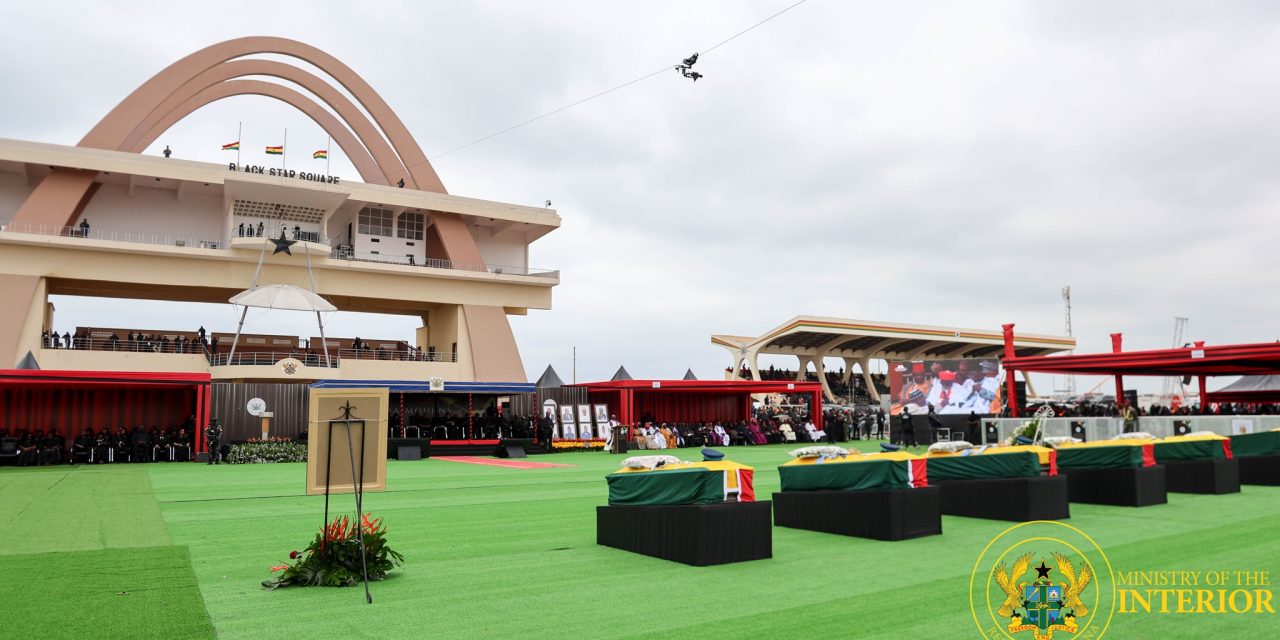
A military helicopter crashed on Wednesday, August 6, a Ghana Armed Forces Z9 helicopter, killing 8 persons, including ministers of state, Dr. Edward Omane Boamah, the Defence Minister, Alhaji Ibrahim Murtala Muhammed, the Environment, Science, and Technology Minister, Alhaji Muniru Mohammed, Deputy National Security Coordinator, Samuel Sarpong, Vice-Chairman of the ruling National Democratic Congress (NDC) and 3 other Officers of the Ghana Armed Forces. May their souls rest in Peace, and God Almighty grant their families divine grace to heal from this tragedy.
That our dear President H.E. John Dramani Mahama was scheduled to fly on the same aircraft on the same day to the state programme raises significant questions, provokes concerns about security, sabotage, assassination, and so on. The catastrophe that could have befallen our beloved country is unimaginable.
For me personally, the loss of a friend, advisor, and comrade, Dr. Omane Boamah, is particularly haunting, being a prodigy of a common security Capo. May their souls rest in perfect Peace.
In this article, I do not claim expertise or special competencies. Instead, I write from a place of mourning and a relentless search for answers. With various rumours circulating, including speculation about an assassination attempt on our dear President and a flood of articles, write-ups, and social media narratives, I have identified what I believe are the 30 most crucial questions, grouped into 4 or 5 categories.
This, therefore, is a dispassionate, civilian quest for answers that hopefully reveals where the root cause for the crash may lie, and aims to ensure that the responsible authorities address the issues to prevent the next crash from occurring.
This is because there have been a couple of helicopter emergency landings before, which could have resulted in loss of life. What was the depth of investigation to uncover the cause of these emergency landings, which, if addressed, might have potentially prevented this most devastating and painful loss of life?
Below, I outline the top 30 questions to be answered, organised under the specified headers: Pilot Competencies, Aircraft Technicals (including Global Safety Records), Environmental Factors, Security and Possible Sabotage, Possible Assassination of the President, Security Protocols, and Other Relevant Factors.
These questions aim to identify the technical cause of the crash, investigate potential criminal motives, and determine the root cause. The investigation will draw on available information, including web sources, while critically examining all possibilities.
Top 30 Questions for the Investigation
Pilot Competencies (Questions 1–6)
These questions evaluate the skills, training, and performance of the flight crew to determine whether human error played a role in the crash. These answers are vital to honouring the brave fallen heroes and to absolve them of blame.
1. What was the training and certification status of Wing Commander Peter Bafemi Anala, the pilot?
Verifying the pilot’s qualifications, especially regarding the Z-9EH model, is essential to exclude insufficient training.
Several social media posts highlight the experience and near daredevil capabilities of the SL. Perhaps he may have been incapacitated at some point during the flight. If he suddenly becomes incapacitated, then he may not have signalled a “Mayday” or SOS call to base. In which case, what suddenly incapacitated him?
2. What was the experience level of Flight Lieutenant Manaen Twum Ampadu, the co-pilot?
Assessing the co-pilot’s experience with transport missions and the Z-9EH aids in evaluating their capacity to manage emergencies. If WC was suddenly incapacitated, could he have taken charge of the craft and averted the catastrophe? As it is, they both lost their lives; therefore, perhaps, they were both incapacitated together?
3. Did the pilot and co-pilot have recent flight hours on the Z-9EH?
Recent flight experience ensures familiarity with the aircraft, reducing the likelihood of operational errors.
4. Were there any prior incidents or performance issues in the pilots’ records?
Reviewing their histories could reveal patterns of errors or lapses that might have contributed to the crash.
It is known that several military and civilian helicopters have made successful emergency landings in the past without loss of life. How thoroughly were these incidents investigated and corrected to avert future occurrences?
5. Did the cockpit voice recorder indicate any pilot errors or miscommunications?
Analysis of the cockpit voice recorder (recovered) could reveal mistakes, such as misjudging altitude or mishandling controls. (https://www.modernghana.com/…/helicopter-crash-black…).
It is reported that several of the 8 Heroes on the abortive flight made phone calls and sent messages from the Helicopter. A compilation, study and analysis of these communications could elucidate the crisis on the flight before the crash?
6. Were the pilots medically fit, and were there signs of incapacitation?
Medical records or toxicology reports could indicate fatigue, illness, or poisoning, potentially linked to sabotage. The state of their bodies might severely frustrate a competent answer. An online video taken and shared on social media during the flight shows both pilots in a high state of alert.
Aircraft Technical Including Global Safety Records (Questions 7–12)
These questions investigate the helicopter’s condition, maintenance, and the Z-9’s global safety record to identify mechanical failures.
7. What was the maintenance history of the Z-9EH (Tail No. GAF-724)?
Reviewing maintenance logs could reveal neglected repairs or recurring issues that led to mechanical failure. (https://en.wikipedia.org/…/2025_Ghanaian_Air_Force_Z-9…).
8. Were there any recent repairs or modifications to the helicopter post-delivery by the manufacturers?
Recent work could have introduced faults or provided opportunities for sabotage, requiring scrutiny of maintenance records.
9. What is the global safety record of the Harbin Z-9EH?
The Z-9EH, a variant of the Z-9 (based on the Eurocopter AS365 Dauphin), has been flagged for safety concerns by aviation experts post-crash, which needs further investigation. (https://yen.com.gh/…/288787-inside-chinese-helicopter…/), (https://hellovybes.com/z9-helicopter-safety-ghana-obuasi…/)
10. Were there known design or manufacturing flaws in the Z-9EH model?
Examining global incident reports could indicate if inherent flaws, such as engine or rotor issues, contributed to the crash.
11. What do the flight data recorder and cockpit voice recorder reveal about system performance?
The recovered black box should provide data on engine, navigation, and control systems to identify technical failures. (https://www.modernghana.com/…/helicopter-crash-black…).
A second-by-second walk-through of the sequence of events that led to the crash is crucial to establishing the cause of the crash. Was the craft burning before the crash? Was the burning a result of the crash? What ignited the fire? Was the aviation fuel leaking before the crash? Or did the fuel tank rupture during the crash process, igniting the fire post-crash?
12. Was the helicopter within its operational limits (e.g., weight, fuel, or altitude)?
Overloading or improper fueling could have compromised performance, requiring analysis of pre-flight logs. The Helicopter is reported to have been flying very low before the crash. Is that to say perhaps they were unable to gain high? It is reported that 3 attempts to land were aborted. Why? What is the nature of the difficulty? Did the pilots issue an SOS? Might the rotor mechanism for adjusting the tilt or azimuth be damaged, preventing altitude gain or reduction?
Environmental Factors (Questions 13–17)
These questions explore weather and terrain conditions that may have contributed to the crash, as reported in eyewitness accounts.
13. What were the weather conditions at the time of the crash in Adansi Akrofuom?
Eyewitnesses and reports suggest poor weather, possibly fog or rain, which might have reduced visibility or affected stability. (https://accradailypost.com/ghana-armed-forces-helicopter…/)
Is this borne out by Official weather reports from the Ghana Meteorological Agency?
14. Did the helicopter encounter unexpected turbulence or wind shear?
Weather data from Ghana’s meteorological agency could indicate sudden weather conditions impacting flight control. It is alleged that 2 other civilian helicopters took off towards the same general destination about an hour after the departure of the Z9. One is reported to have returned to base, and the other made an emergency landing elsewhere. If confirmed, then abnormal weather phenomena might be the root caused.
15. How did the forested terrain and mountainous area affect the flight?
The crash site was a thick forest near a mountainside, which may have posed navigation challenges. (https://en.wikipedia.org/…/2025_Ghanaian_Air_Force_Z-9…) (https://yen.com.gh/…/288696-missing-ghana-army…/).
16. Was the flight plan adjusted for known weather or terrain risks?
Checking if pilots were briefed on conditions and adjusted altitude or route could reveal planning oversights.
17. Did low altitude contribute to the crash, as suggested by eyewitnesses?
Reports indicate the helicopter was flying low, hitting a tree before a mountain, which needs verification against flight data. (https://yen.com.gh/…/288696-missing-ghana-army…/) (https://ghanafact.com/ghana-armed-forces-helicopter…/).
Did the rotors hit trees? Is there evidence of tree top branches chopped off? Pictures of the crashed craft show that none of the rotors remained attached to the craft. Where were the rotors found relative to the craft post-crash? Did the craft on hitting the ground, spin multiple times, leading to the passengers being perhaps flung away from the craft? If the bodies were perhaps in different locations, how come they all got burnt?
Security and Possible Sabotage (Questions 18–23)
These questions probe vulnerabilities in security protocols and evidence of deliberate tampering with the helicopter.
18. Who had access to the Z-9EH before takeoff from Kotoka International Airport?
Identifying ground crew, maintenance staff, or others with access could uncover opportunities for sabotage. (https://en.wikipedia.org/…/2025_Ghanaian_Air_Force_Z-9…)
19. What security measures were in place to protect the helicopter?
Examining protocols at the airbase, such as surveillance or restricted access, helps assess vulnerabilities.
20. Were there any reported security breaches at the airbase before the flight?
Unreported or undocumented incidents could indicate how sabotage was executed.
21. Does forensic analysis of the wreckage show signs of explosives or tampering?
The wreckage was on fire, but residue analysis could reveal sabotage, such as planted explosives. If an explosive, are there signs of deformed metal parts around the epicentre of the explosive device?
Explosive shrapnel, both in wreckage and on bodies? A metal detector scan of bodies is required before burial. The continuous security of the crash site is therefore crucial to ensure that residue materials are not evacuated or washed away. (https://en.wikipedia.org/…/2025_Ghanaian_Air_Force_Z-9…) (https://yen.com.gh/…/288696-missing-ghana-army…/)
Further analysis ought to establish if an explosive was involved. Was this explosive already planted on the craft before departure, or was it from an external source, perhaps fired from the ground or forest? This is crucial to establish if a rifle of sorts was used or perhaps a surface-to-air missile like a MANPADS.
22. Were there unusual maintenance or access logs for the helicopter?
Anomalies in logs could point to unauthorised interventions by insiders or external actors.
23. Who was responsible for overseeing the helicopter’s security at all material times?
Identifying the chain of command for security establishes accountability for any lapses.
Possible Assassination of the President and Security Protocols (Questions 24–28)
These questions focus on the assassination hypothesis, given the president’s original plan to be on the flight, and related security measures.
24. Who knew the president was originally scheduled to be on the flight, and at what point did they know?
The president delegated ministers to attend the event, so identifying who was aware of his plans could reveal a targeted attack.
It is reported that several ministers were present at the departure of the helicopter; therefore, the flight schedule was common knowledge. This could point to a fundamental breach of security. Is it necessary for so many high-level Ministers of state to be present at any one function? (https://en.wikipedia.org/…/2025_Ghanaian_Air_Force_Z-9…)
Would the President have used the same aircraft for his journey, or would that have changed because of his larger entourage?
25. Were there specific threats against President John Mahama or the ministers?
Intelligence reports or prior threats could indicate motives, especially given the mission’s focus on illegal mining enforcement. (https://ghanaregions.com/ghana-military-helicopter-crash/)
26. What security protocols governed the president’s travel arrangements?
Understanding how the president’s schedule was managed, communicated and changed could reveal if the attack was misdirected. The President’s movement, itinerary, travel plans and routes are matters of national security and must be closely guarded.
27. Who would benefit from the president’s or ministers’ deaths?
Investigating political, economic, or regional actors (e.g., illegal mining interests, military saboteurs) could uncover motives for assassination.
28. Did the president’s absence from the flight result from a last-minute change?
Timing and reasons for the president’s decision not to board could indicate whether the crash was intended for him. (https://en.wikipedia.org/…/2025_Ghanaian_Air_Force_Z-9…)
Other Relevant Factors (Questions 29–30)
These questions cover additional angles to ensure a comprehensive investigation.
29. What was the mission’s strategic importance, and could it have provoked sabotage?
The flight was tied to combating illegal mining (“galamsey”), a contentious issue, which may have motivated adversaries to act. (https://ghanaregions.com/ghana-military-helicopter-crash/)
30. Were there similar incidents involving Ghana Armed Forces aircraft recently?
A prior GAF helicopter incident in March 2024 with no fatalities suggests a need to compare patterns or recurring issues. (https://accradailypost.com/ghana-armed-forces-helicopter…/)
Where, What, Perhaps, Might Be the Root Cause of the Disaster?
Determining the root cause, in my view, depends on the investigation’s findings across technical, human, environmental, and criminal factors. The following scenarios outline potential outcomes and responsible parties:
1. Mechanical Failure
Evidence: Maintenance logs show neglected repairs, or the black box indicates system failures (e.g., dual engine or rotor issues). The Z-9’s safety record is under scrutiny, with experts raising concerns post-crash. (https://hellovybes.com/z9-helicopter-safety-ghana-obuasi…) (https://www.classfmonline.com/…/GAF-begins…)
The root cause:
- Maintenance crew, for failing to address issues.
- Harbin Aircraft Manufacturing Corporation, if design flaws are confirmed.
Example: If question 7 reveals skipped inspections, the maintenance team or oversight officers are culpable.
2. Pilot Error
Evidence: Cockpit voice recorder or flight data show misjudgements, such as flying too low or mishandling weather conditions, as suggested by eyewitness accounts of low altitude. (https://yen.com.gh/…/288696-missing-ghana-army…/)
The root cause:
- Pilots, if errors are confirmed.
- Ghana Air Force training programs, if pilots lacked adequate preparation for the Z-9EH or the weather conditions.
Example: If question 5 indicates pilot miscommunication or incorrect manoeuvres, the pilots or their trainers bear responsibility.
3. Environmental Factors
Evidence: Weather reports confirm poor visibility or fog, and eyewitnesses note that the helicopter hit a tree and a mountain, suggesting terrain challenges. (https://ghanafact.com/ghana-armed-forces-helicopter…/)
The root cause:
- Flight planners, if they failed to account for known weather risks.
- Pilots, if they did not adjust for conditions despite briefings.
Example: If question 13 confirms severe fog and question 16 shows no route adjustment, planners or pilots may be at fault.
4. Sabotage or Assassination Attempt
Evidence: Forensic analysis finds explosive residues, or security logs reveal unauthorised access (questions 21–22). The president’s original plan to be on board and the mission’s focus on illegal mining raise motives for targeting key figures. (https://en.wikipedia.org/…/2025_Ghanaian_Air_Force_Z-9…) (https://ghanaregions.com/ghana-military-helicopter-crash/)
The root cause:
- Perpetrators, if sabotage is confirmed (e.g., insiders or external actors like illegal mining cartels).
- Airbase security personnel, if breaches allowed tampering (questions 19–20).
- National security coordinators, if threat intelligence was ignored (question 25).
Example: If question 21 detects sabotage and question 24 identifies who knew the president’s schedule, the root cause falls on the saboteurs and security lapses.
5. Combined Factors
Evidence: The crash could result from multiple issues, such as poor weather exacerbating a mechanical fault or pilot error compounded by inadequate security.
The root cause: Shared across maintenance teams, pilots, planners, and security, depending on the contributing factors’ weight.
Example: If questions 13, 7, and 5 show fog, poor maintenance, and pilot error, the root cause is distributed accordingly.
Conclusion
The investigation into the Z9 helicopter crash on August 6, 2025, must address these 30 questions at a minimum to uncover the technical cause, whether mechanical, pilot error, or environmental, and determine if criminal intent, particularly an assassination attempt on H.E. President John Mahama, was involved. The recovered black box and ongoing interagency investigation (involving the Ghana Armed Forces, Ministry of Defence, Civil Aviation Authority, and national security agencies) will be critical.
Given the high-profile passengers and the president’s near-involvement, a transparent process, possibly involving international aviation experts, is essential to ensure credibility.
The root cause will depend on evidence, potentially implicating maintenance crews, pilots, planners, security personnel, or external actors. The mission’s link to illegal mining enforcement heightens the need to explore sabotage motives thoroughly.
Until conclusive findings are released, all scenarios remain plausible, and the investigation must be rigorous to deliver justice and prevent future tragedies. (https://www.modernghana.com/…/helicopter-crash-black…) (https://www.myjoyonline.com/ghana-armed-forces-launches…/) (https://ghanaregions.com/ghana-military-helicopter-crash/)
Dedicated to the 8 fallen heroes of 2025, particularly my friend, advisor and comrade Dr. Omane Boamah.
May their souls rest in eternal Peace, and the Divine Grace of our God Almighty heal the pain of their families!!!
My two pesewas!!!
LESLIE MENSAH TAMAKLOE